Showing posts with label WWII. Show all posts

Tuesday, September 21, 2010

WWI on the Lagazuoi

I've been away from the blog for a while because I was hiking with my father in the mountains.
Now that he is gone, I would like to share one trail and location with you. It combines history with glorious mountain panoramas. That is the Mount Lagazuoi, a stronghold for the Italian and Austrian troops during WWI.

View of Lagazuoi with cable car from Passo Falzarego


We started our hike up the Austrian side, leaving Passo Val Parola and following the route Kaiserjaeger. The Austrians had this side and the top of Lagazuoi as its defence. Along with the neigbouring Sas de Stria (see post), it created and almost invincible defence strategy because they could see far into the valleys and along the only paths that the Italians needed to gain territory.

Val Parola Pass and the Austrian fort Tre Sassi

A view of Sas de Stria and the Marmolada (with glacier) in the distance


The trail features a suspended bridge that is a special treat along the hike. This is not the most common route to take up the mountain since it is a little bit more difficult than the one going up the front of the mountain at Passo Falzarego. However, I find it more interesting to take since it focuses on the Austrian front before we will switch over to the Italian section. It also presents the hiker with a separate side of the mountain and its views to take in, which differ from the second section of the day's walk.


The summit is always gratifying, here at 9029 ft.


Me with Mount Marmolada in the background, where there is a small museum dedicated to the Great War.


Rifugio Lagazuoi


After a short lunch, we passed the Rifugio Lagazuoi (which is reachable directly by cable car) and headed into the gallerie (tunnels) which were carved 1 km long through the mountain. The darkness, dampness, tight quarters and slippery steps make you think hard about the soldiers' problems while fighting that war. The winters were devastating. It was hard to survive, let alone fight in those conditions. My father hit his helmet-protected head about a dozen times on the ceiling while trying to make it down the tunnel just once. He is tall, but I don't think the soldiers had it too easy avoiding the same bumps a century ago. And the soldiers were there for 4 long years.

Tunnel


Artillery perch


Every so often, hikers now catch a view a great view from what used to be the artillery points and defensive holes which act as windows now.

The tunnel ends at the Cengia (Ridge) Martini, an Italian position under the Austrian line, protected by some rock formations.


The last half an hour of walking is an easy stroll down to Passo Falzarego.


If you are a WWI buff and like to hike, this is the place to go!

For more information about WWI , consult the following site: click Museo della Guerra, focusing on the nearby Trentino region but also including information about the Veneto front; Museum of the First World War in Marmolada; Five Towers open air museum in Lagazuoi area featuring still lifes of the war scenes with mannequins.

For more information about hikes in the area: click Cortina.Dolomiti.org

Monday, August 16, 2010

Day Trip to Bassano del Grappa


This town provides a wonderful day-trip solution from Padua or Venice. Located 70 km from Padua, Bassano del Grappa is most famous for its grappa production, ceramic traditions and wooden bridge over the River Brenta.

Currently the cultural life in Bassano del Grappa is percolating with the programming for Opera Estate 2010. From the end of June to early September, a series of international dance companies, theatre groups, readings and opera will be performed in the area. For more information, click here.

Take a walk through the town and visit the many museums, dedicated to ceramics, the artist Jacopo Bassano, the tower and the civic museum. Visit the tourist information point near the old city walls by the train station for more information about all of them and a map of the city.


Around the old bridge, several shops sell Bassano's famous ceramics and stoneware. They feature painted plates and bowls, elaborate white stoneware and delicate ceramic fruit compositions.


Piazza del LibertĂ  during a summer shower


A café in Piazza Garibaldi with ceramic art on the outside walls

The lion with wings that marks all the towns that were once dominated by the Serenissima (Venetian Republic). After it's protection for a while in the 13th century by a Paduan, Ezzelino II, the Ventians took hold in the 15th century, followed by Napolean's reign. Eventually Bassano became officially part of the province of Vicenza, which it still maintains today.

The oldest building in town, built in the 13th century
A clock tower, the Torre Civica
Another clock (building)

Local specialties on display in the historic bread shop, here featuring ciamballone.
An antique shop in the city center
The large wooden bridge has many names: Ponte di Legno, Ponte degli Alpini (in honor of those who last rebuilt it) and Ponte Vecchio. Even Andrea Palladio was involved in designing and building this large bridge which crosses a rough river, the Brenta. A wood structure was thought to be able to withstand the river's force. Unfortunately that wasn't always true. The bridge has crumbled many times over the centuries, although the last demise came at the hands of the Nazi Germans. The bridge was bombarded during WWII. What you see now is the 1947 reconstruction, based on Palladio's original plans from 1569.

Ponte degli Alpini


A plaque on the bridge in honor of the fallen during WWII.


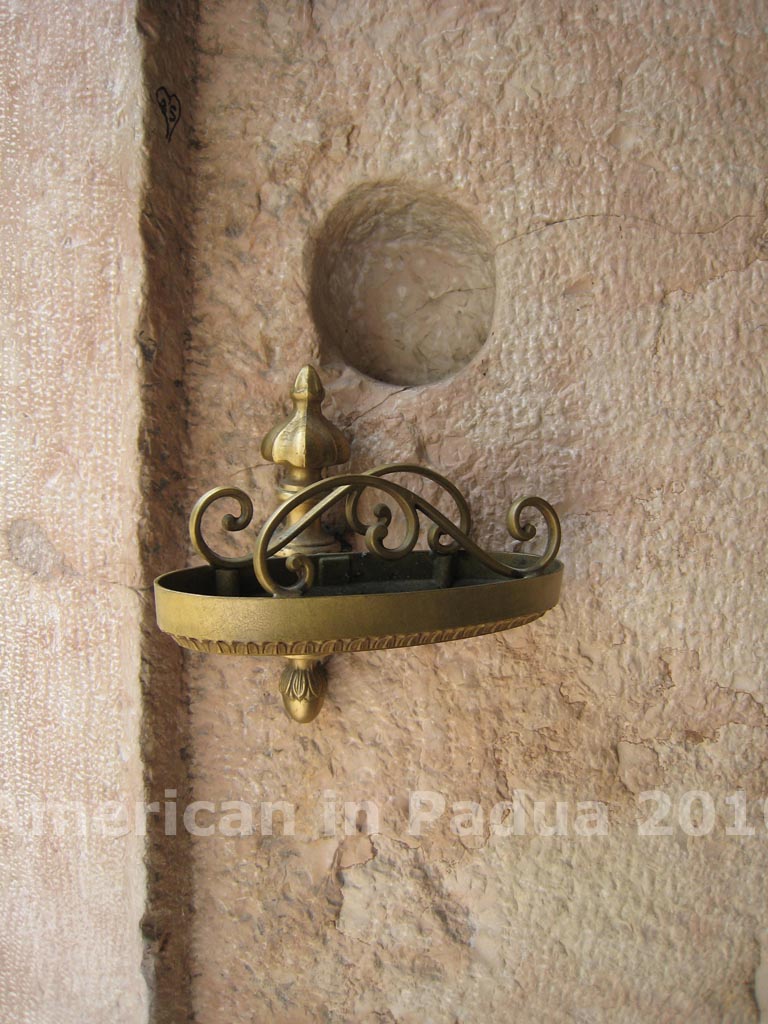
The most elegant outdoor ash tray I've ever seen.


When visiting the town, don't miss a trip to the bar Distilleria Nardini at the end of the Ponte degli Alpini. Have a shot of Italy's strongest spirit, grappa, and take home a bottle. I prefer the Acquavite stagionato (aged grappa) with its golden coloring. But beware, it is quite strong at 50% alcohol content. Drinking a shot in the old bar proves special since the decor envelopes you in heavy dark wood impregnated with the acquavite scent.

At the very least, Bassano del Grappa is a pleasant afternoon stroll with characteristic architecture and little local delicacies as wells as souvenirs to satisfy most touristy souls. Enjoy a day at the edge between the northern Italian plains and mountains. Witness how people can restore their splendor after the devastation of war. Make a jaunt to Bassano.

To get to Bassano, you can take the regional train or buses (SITA or FTV) from Padua. The trip takes about an hour. Or you can make Bassano your homebase by staying a couple of nights and exploring the nearby mountains and Padana plains. Bassano is strategic since it sits at the foot of the Prealpi (Pre-alps) of Vicenza.

Photo sources:
Overall bridge view: fulviatour.com
Ceramics store: Cippetta-Vicenza @ flickr.com