Showing posts with label old walls. Show all posts

Sunday, May 5, 2013

Cittadella Inaugurates the Full Wall Walkabout

In Italian, Cittadella's medieval wall walkabout is called Camminamento di Ronda delle Mura.


After twenty years of slow-and-steady restoration, the full circle is ready to open to the public the first week of June. Festivities will begin on the first of the month for nine days.


For a list of events (in Italian), click here.


This wall dates back to about 1220 and wraps around 1460 meters (0.90 mile) to circle the city. The walking area on the wall is 13 meters (42 ft.) high and offers a fantastic glimpse of this small and well-kept city from above. You can peek down and see gardens, the amphitheater and marvel at the girth of the city's cathedral rising from the center of Cittadella. There are 5 doors to the city and the moat still exists. There is an archeological museum to visit as part of your ticket to walk around the walls and the display of medieval weaponry at the entrance to the museum is fun for the whole family to look at.

Cittadella is located 36 km (22 mi.) north of Padua and can be reached using the SITA buses, if you don't have a car. Free car parking is located just outside of the walls at Porta Padova.  For SITA hours, click here.

 Last week, I was able to walk the current 3/4 of the camminamento that is open now on a glorious spring day.


near Porta Bassano


 Amphitheater


 view from Porta Padova

Dante Alighieri made reference to the terrible dungeon built in Porta Padova by Ezzelino da Romano in 1251 in his trilogy of the Divina Commedia.

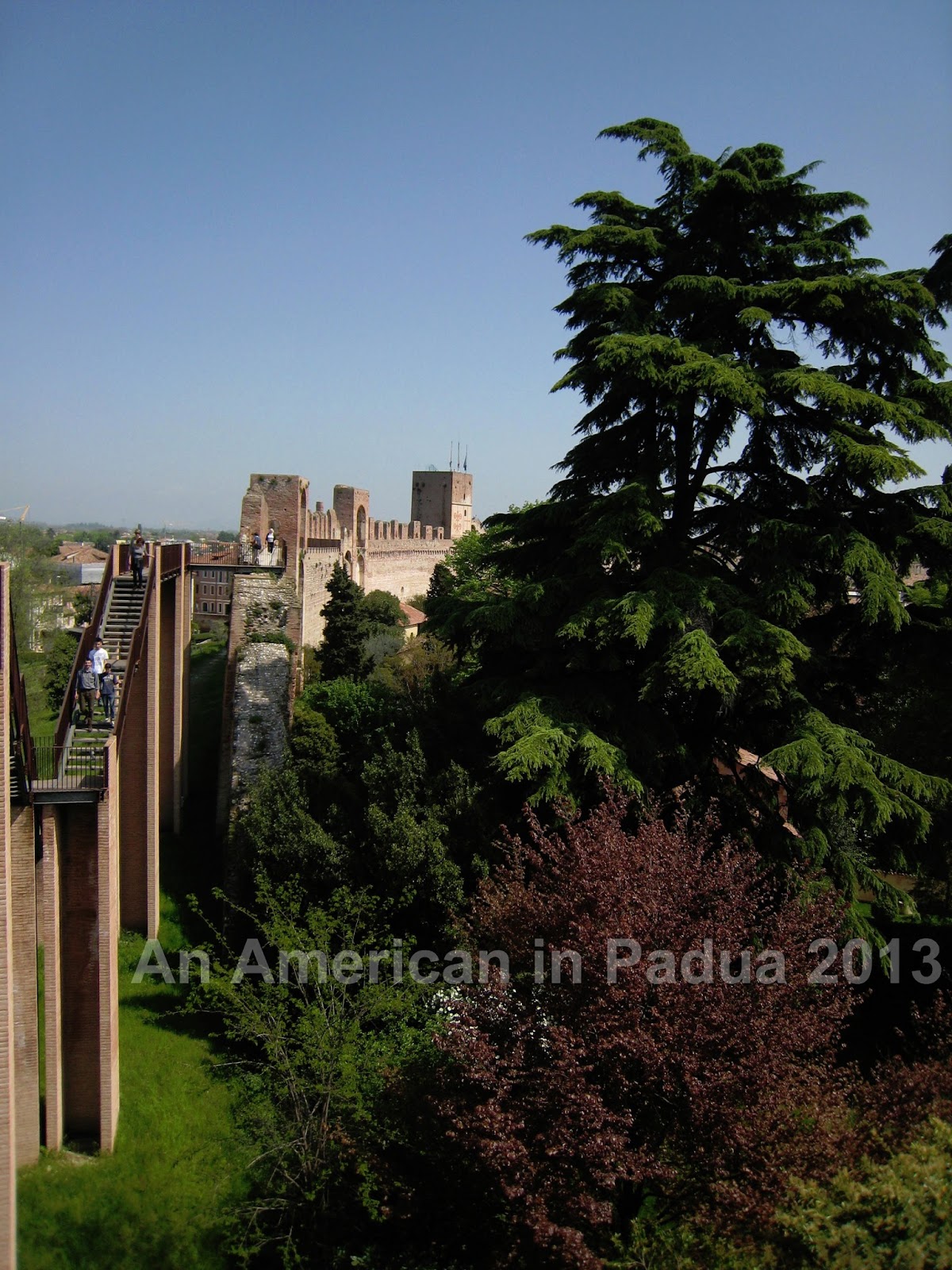


the most obvious section of the restoration which recovered the missing area of wall west of Porta Bassano


Tickets cost Euro 7 per person

Hours vary summer and winter:
1 November - 31 March
Mon-Fri 9 a.m. - 1 p.m./ 2 - 4 p.m. (last entrance 45 minutes before closing)
Tuesdays closed
Sat-Sun 10 a.m. - 5 p.m.
1 April - 31 October

Mon-Fri 9 a.m. - 1 p.m./ 2 - 6 p.m. (last entrance 45 minutes before closing)
Tuesdays closed
Sat-Sun 9 a.m. - 1p.m./ 3 - 7 p.m.


Ufficio IAT Cittadella
Porte Bassanesi, 2
35015 Cittadella
Tel. 049-9404485
Fax. 049-5972754

Thursday, October 22, 2009

Writing on the Wall: Portello


Porta, Scalinata e Ponte Ognissanti

This door to the city marks the university center for Padua since it has the largest concentration of university buildings in the area. The name is also borrowed to describe the residential area in its vicinity, "Portello". But it's first role was as a customs house when Padua still had all of its walls in place and it remained active long after the other city doors' lost their utility.

It was constructed in 1518-19 for Captain Marcantonio Loredan with an Istria stone facade by Guglielmo Grizi ("The Bergamasco"). The bridge dates from 1784 and connects Via Portello to the Istituti Universitari and fairgrounds to the north. On the other side of the door, there is the Edicola di Santa Maria dei Barcari, 1790, in a decorative chapel. Yet the steps seems to actually be the highlight since Canaletto supposedly depicted them and Barbarigo used them to welcome the Venetian authorities visiting Padua. On a warm spring day, you can spot numerous university students reading on them as the sunlight showers down.

In 1993, those steps, la scalinata della Fraglia, were put to public use, recently restored and have been monitored by the association Amissi del Piovego. They hold a market on the last Saturday of the month, Portello Cartastorie. Touristi boats leave there for tours along the Brenta, too. Then in the summer months of June and July, a temporary and floating screen is place in the canal and 4 weeks of events are planned around the Portello River Festival, including some of Hollywood's latest movies, experimental cinema, local documentaries, jazz concerts and short-film events.

For two years, the Portello area was completely transformed during the hot months (June-September) because all the local bars set up stands to serve their clientele along this canal instead of packing the city center with rambunctious teenagers and young adults with a buzz. It was a lot of fun because each stand created a different theme which was distinct from the next. You could walk down the road and drink at the "tropical" stand or "fashion" bar. It was a festival of color and furniture styles. Unfortunately the neighbors complained about noise and the city disbanded the concentration of bars this past summer.

This door is one of the most active still today. Hundreds of students walk and bike under its triumphal arch, not to mention the markets and festivals that take place here.

Thursday, August 20, 2009

Writing on the Wall

A Relationship Between the Military and Farming in VI Century Padua

Padua's walls needed to protect the city in military fashion and farmers provided a useful element to that end.

Military tactics and farming's symbiosis:

Enemies could be watched in an "invisible" fashion from Padua's walls that were angled in such a way to render them "hidden" from an enemy's advancing eye. Cannons and hakbuts would be used to quell the forwarding enemy by surprise. A relatively open land area one mile wide was maintained outside of the walls, with a moat placed at its feet and only a few doors constructed to allow access to the city. In this large and empty space, farmers were allowed to grow certain crops as long as the plants did not reach heights of more than one meter (3 ft). Those crops hid trapdoors, sharp rocks and low bundles of wood that made passage dangerous and noisy for invaders who were not extremely careful. The farming solution helped keep the land in a militarily ideal situation of "open" area while not weighing heavily on the government's financial investment which would have otherwise been necessary from constant expenditures due to cleaning, pruning and general land maintenance.

Various cereals were the preferred crops that grew at the feet of the Padua's old walls because of the plants' perfect height and the fact that it also offered basic sustenance to the city's inhabitants. Once harvested the wheat, grain, oats, etc. would be processed in the mills located inside or along the walls. Ponte Molino, which I will feature in the next entry, is evidence of that tradition.

Monday, August 10, 2009

Writing on the Wall


WALL SPRAWL

I started with a walked along the Bastione Cornaro that parallels Via Gattamelata on the southern end of Padua. I noticed that the hospital structures seem to spring up out of the walls. In one case, the chapel shares a brick extension from the old wall into its foundation and its own external wall. How did this happen?

Well, the city decided to buy up the property immediately around and on top of the wall once its defensive features were no longer necessary, which became official in the nineteenth century. By the twentieth century, that city ownership led to many public or semi-public institutions constructing buildings in the wall's vicinity, where the terrain was free or very cheap. The hospital is a perfect example of this flurry of wall-construction and, supposedly, there are many schools that border it, as well.

Basically, public buildings grow like mushrooms around contemporary Padua's old fortress wall.